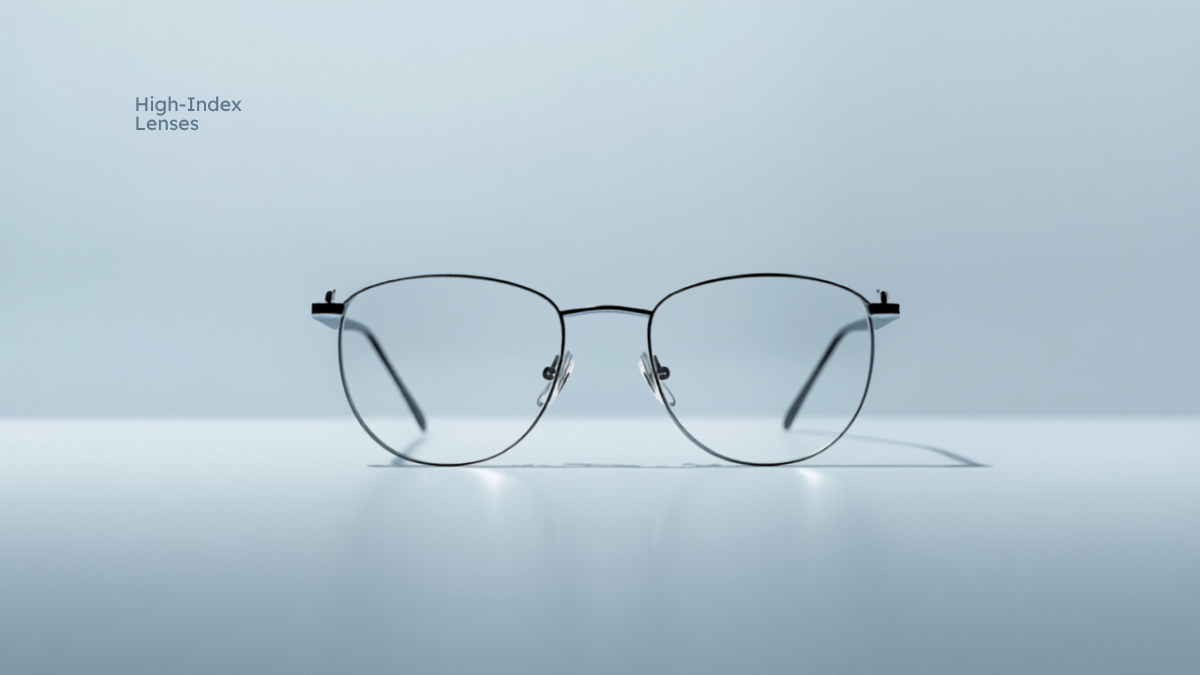
High-Index Lenses: Thinner, Lighter Glasses for Strong Power (হাই-ইনডেক্স লেন্স)
Have you ever chosen a lovely frame, only to end up with thick, heavy lenses that bulge out at the edges? If you have a strong power, that “coke-bottle” look is a common frustration. The fix is a smarter lens material: high-index lenses (হাই-ইনডেক্স লেন্স) — noticeably thinner and lighter, even for a high prescription.
What are high-index lenses? (হাই-ইনডেক্স লেন্স কী?)
“Index” refers to how strongly a lens material bends light. A high-index material bends light more efficiently, so less material is needed to correct the same power. The result is a lens that’s slimmer, flatter, and much lighter on your face than a standard lens of the same strength.
How the “index” number works
The higher the number, the thinner the lens:
- 1.50 — standard (CR-39); fine for low powers but thick at high powers.
- 1.59 — polycarbonate; thinner and impact-resistant.
- 1.67 — high-index; clearly thinner, great for moderate–strong powers.
- 1.74 — the thinnest widely available; ideal for very strong prescriptions.
বাংলায়: চশমার পাওয়ার বেশি হলে সাধারণ কাচ মোটা ও ভারী দেখায়। হাই-ইনডেক্স লেন্স (১.৬৭ বা ১.৭৪) একই পাওয়ারে অনেক পাতলা ও হালকা হয়।
Who benefits most?
- Anyone with a strong prescription (high myopia or hyperopia).
- People who want rimless or metal frames, where thick edges show badly.
- Anyone who wants lighter, more comfortable glasses for all-day wear.
Pros & cons
| Pros | Cons |
|---|---|
| Much thinner & lighter lenses | Costs more than standard lenses |
| Flatter, more attractive look | More reflective — needs a good coating |
| Better for strong powers & rimless frames | Overkill for very low powers |
High-index lenses & coatings
Because thinner high-index lenses reflect a little more light, an anti-reflective (AR) coating is strongly recommended — it removes distracting glare and makes the lenses look almost invisible. Not sure which lens design to pair it with? See our single vision vs progressive vs bifocal guide.
Are high-index lenses worth it?
If your prescription is moderate to strong, absolutely — the comfort and appearance are a big upgrade. For a very low power, standard lenses are already thin enough, so you may not need to pay extra. The right choice depends on your exact power, which you’ll find on your eye prescription.
Want thinner, lighter glasses? Nine Optic’s free home try-on lets you choose the right frame and lens from home, with cash on delivery.
Frequently Asked Questions
Do I need high-index lenses?
They’re most worthwhile if you have a moderate-to-strong prescription or want rimless frames. For low powers, standard lenses are usually thin enough.
Are high-index lenses lighter?
Yes. They use less material for the same power, so they’re noticeably thinner and lighter — much more comfortable for all-day wear.
What is the thinnest lens available?
1.74 high-index is the thinnest widely available option, ideal for very strong prescriptions. 1.67 is a great choice for moderate-to-strong powers.
Do high-index lenses need special coatings?
An anti-reflective coating is highly recommended, as thinner high-index lenses reflect slightly more light. It improves both clarity and appearance.
Share This Story, Choose Your Platform!
About the author : Dr. Saifur Rahman

Senior Consultant, Uttara Eye Hospital, Dhaka