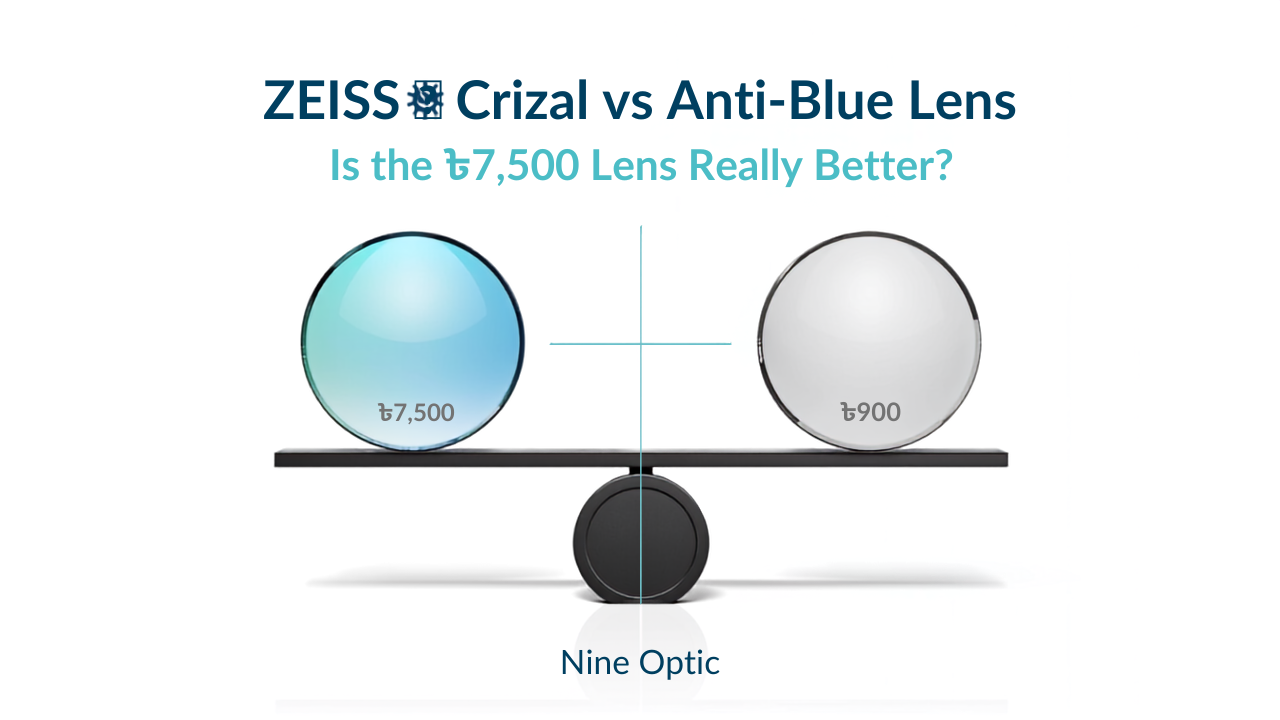
ZEISS, Crizal নাকি সাধারণ Anti Blue Lens? ৭৫০০ টাকার লেন্স কি সত্যিই ৯০০ টাকার লেন্সের চেয়ে ভালো?
New: for the complete picture — do they work, brands, price and how to choose — see our complete honest guide to blue-cut lenses in Bangladesh.
Walk into two optical shops on the same street in Dhaka and ask for an “anti-blue lens.” In the first, you are quoted ৳900. In the second, the optician shows you a ZEISS or Essilor Crizal lens and the price jumps to ৳7,500 or more, for the same eye power and the same “blue light protection” claim. It is one of the most confusing experiences for a first-time spectacle buyer in Bangladesh, and a fair question to ask: is the expensive lens genuinely better, or are you paying for a sticker and a brand name?
The honest answer is that it depends, because the difference is real but it is not always worth it for everyone. A ৳7,500 lens is not “8 times clearer,” yet it is also not a scam. The gap is filled by things you cannot see across a shop counter: the purity of the lens material, the number and quality of microscopic coatings, manufacturing precision, quality control, and warranty. This guide explains where that money goes, who genuinely benefits from premium lenses, and who can be perfectly happy with a well made generic lens.
1. Why anti-blue lenses range from ৳900 to ৳8,000+ in Bangladesh
The price spread exists because “anti-blue lens” is a category, not a single product. Two lenses can look identical on the counter yet differ hugely in material quality, coating layers, optical precision and durability. The cheapest options use basic substrates and a single thin coating, while the most expensive use highly purified material, multi-layer coatings, tight tolerances and a brand warranty. Once you understand how a lens is actually built, the price differences become far less mysterious.
2. How a spectacle lens is actually made
A modern lens is not a single piece of plastic. It is a layered, engineered product, and the differences you pay for are mostly invisible.
The substrate (base material)
| Material | Index | Typical use |
|---|---|---|
| CR-39 plastic | 1.50 | Low powers, budget |
| Polycarbonate | 1.59 | Kids, sports, rimless |
| Mid-index | 1.56 to 1.60 | General use |
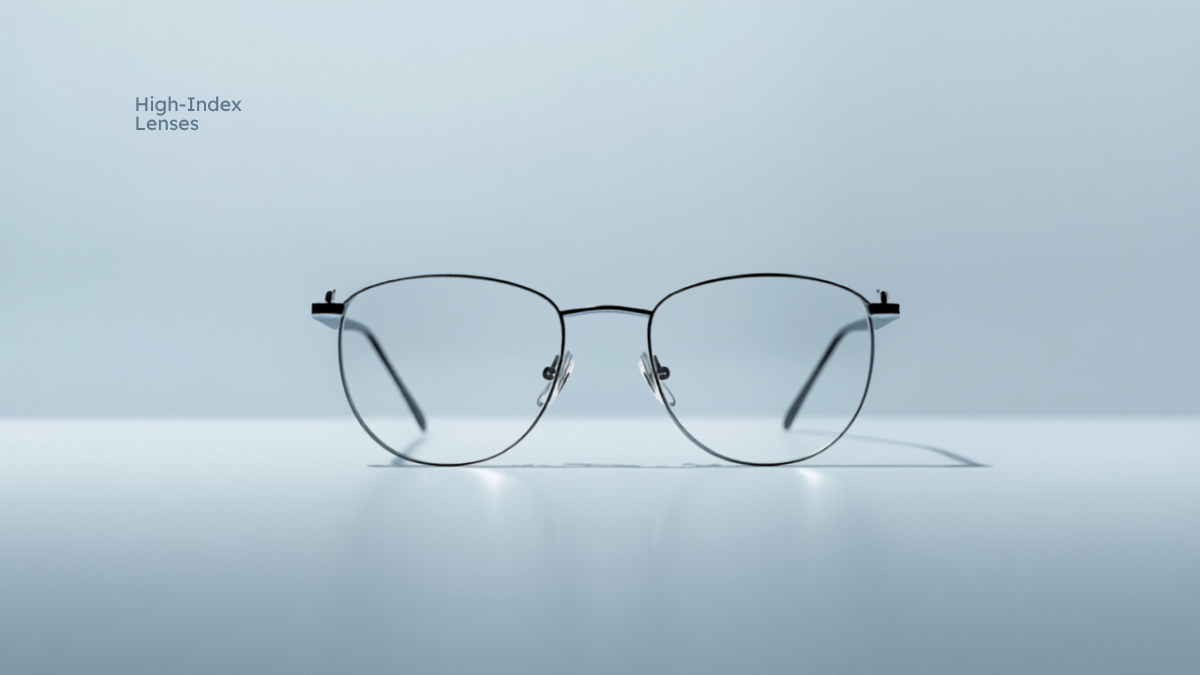
| High-index | 1.67 | Higher powers (thinner) |
| Ultra high-index | 1.74 | Strong prescriptions (thinnest) |
The quality of the substrate matters as much as the index. Premium makers use highly purified, optically consistent material, while cheaper blanks can carry minor internal stress or uneven curvature that causes subtle blur or eye strain over long hours. To understand which base material suits you, see our guide on prescription lens options.
The coatings, layer by layer
- Hard coating hardens the surface against everyday scratches.
- Anti-reflective (AR) coating is the heart of a good lens: a stack of multiple ultra-thin layers applied in a vacuum, reducing reflections so more light reaches your eye. Learn more on our anti-reflective coating page.
- Hydrophobic layer repels water, which is very useful in Bangladesh’s humidity and rain.
- Oleophobic layer repels skin oil and fingerprints, so the lens stays clean and wipes clear for years.
Blue light filtering
There are two ways to filter blue light. The first is substrate absorption, where filtering molecules are built into the material. The second is coating reflection, which creates the blue or purple sheen you see on many anti-blue lenses. Importantly, the scientific evidence that blue-light filtering prevents eye damage or improves sleep is weak and mixed. What genuinely reduces digital eye strain is a good AR coating, the correct prescription, proper lighting and regular breaks. So a premium lens mostly buys you optics and coating quality rather than a blue-light cure. If screen comfort is your goal, our blue light lenses page explains what actually helps.
3. Are ZEISS and Essilor lenses manufactured in China?
This is a reasonable question: “If it is made in China anyway, why pay more?” The reality is that ZEISS, Essilor, Hoya and Shamir all operate manufacturing and surfacing labs in many countries, including China, Thailand, India and the Philippines. A lens often passes through several countries before it reaches you.
“Made in China” on a genuine branded lens does not mean it equals a ৳900 generic lens. A brand-owned factory runs the same equipment, coating recipes, quality-control standards and certifications as the brand’s other plants. The country is just the address, while the controlled process is what actually differs. A generic lens may also be made in China, but in a third-party factory with cheaper equipment, looser tolerances and no obligation to meet a global brand’s quality control.
Buyer caution: because the name carries a premium, counterfeit “ZEISS” and “Crizal” lenses do exist. Genuine lenses come with authenticity certificates and engraved markings, so it helps to read our detailed guide on how to identify original ZEISS lenses in Bangladesh.
4. Where does the extra money actually go?
| Cost driver | What you pay for | Felt daily? |
|---|---|---|
| Research and Development | Decades of optical and coating research | Indirectly |
| Coating technology | More AR layers, durable hydrophobic and oleophobic top coats | Yes |
| Quality control | Tight tolerances, batch testing, high reject rates | Yes |
| Optical precision | Accurate power, low distortion, smooth progressive zones | Yes |
| Warranty | 1 to 2 year coating, scratch and peeling cover | Yes |
| Brand and distribution | Name, marketing, authorized lab network | Mostly perception |
| Certification | ISO 8980 and ANSI Z80 compliance | Indirectly (trust) |
A meaningful chunk of the premium goes into real, experienceable quality such as coating durability, optical precision, consistency and warranty. Another chunk goes into brand and marketing, which you do not directly “wear.” A smart buyer pays for the first and stays aware of the second.
5. Side-by-side comparison
Two clarifications that the marketing tends to blur. First, Crizal is a coating, not a lens; it is Essilor’s premium anti-reflective coating. Second, ZEISS, Hoya and Shamir are full lens makers. You can explore each on our ZEISS lens, Essilor Crizal lens and Hoya lens pages.
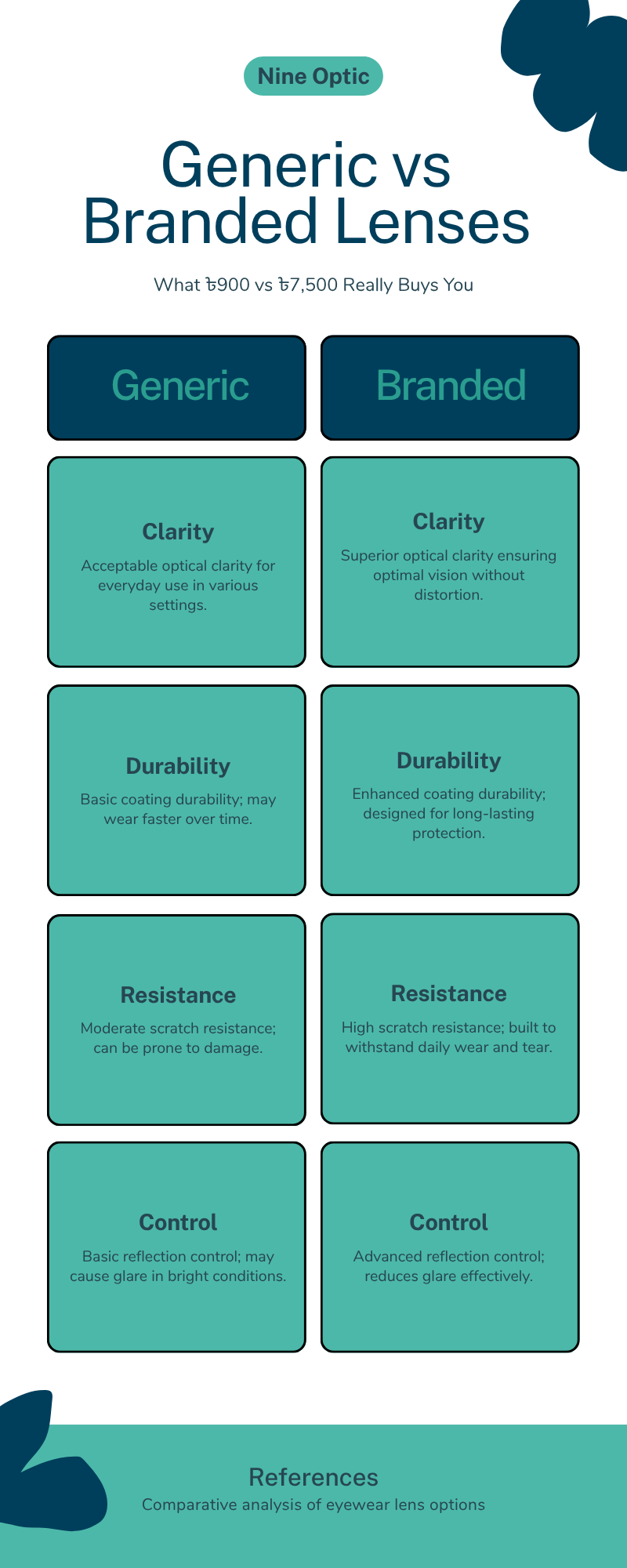
| Feature | Generic Anti-Blue | Essilor Crizal | ZEISS | Hoya | Shamir |
|---|---|---|---|---|---|
| Optical clarity | Acceptable to good | Excellent | Excellent | Excellent | Excellent |
| Coating durability | Low to medium | High | High | High | High |
| Scratch resistance | Variable | High | High | High | High |
| Reflection control | Basic | Premium | Premium | Premium | Premium |
| Long-term performance | May degrade in 6 to 18 months | Stable for years | Stable for years | Stable for years | Stable for years |
| Consistency | Variable | Very consistent | Very consistent | Very consistent | Very consistent |
| Warranty | Usually none | 1 to 2 yr | 1 to 2 yr | 1 to 2 yr | 1 to 2 yr |
| Typical price (single-vision) | ৳700 to ৳1,800 | ৳4,500 to ৳12,000+ | ৳5,000 to ৳15,000+ | ৳4,000 to ৳12,000+ | ৳4,500 to ৳13,000+ |
The realistic summary is that the biggest and most consistent differences are in coating durability and long-term performance, not in day-one clarity. A good generic lens can look nearly as clear as a ZEISS on the first day, and the gap appears at months 6, 12 and 24.
6. Are consumers being cheated?
The direct answer is no, premium lenses are not a scam, but no, not everyone needs them.
Premium is worth it when you wear glasses 8 to 12 hours a day, have a high prescription or astigmatism, need progressive lenses (where design quality matters most), are hard on your glasses, or keep them for 2 to 3 years.
Premium is not worth it when your power is low, your use is occasional, you replace glasses every year, or you are buying purely for “blue light protection.”
Generic gives excellent value for students, spare pairs, and low to moderate prescriptions with normal use. The real waste is buying the cheapest lens with a weak coating that peels in a year, or overpaying for a premium lens you will replace in eight months.
7. Which lens should you buy?
| Profile | Best lens category | Why |
|---|---|---|
| Student (limited budget) | Good mid-range generic with quality AR | Affordable, and you can spend more on accurate power |
| Office executive | Premium single-vision (ZEISS, Crizal, Hoya, Shamir) | Comfort, durability and warranty over long hours |
| Heavy computer user | Premium AR coating (blue filter optional) | Glare control is the real benefit |
| Reading-glass user | Mid-range single-vision, good AR | Low power means a small optical gap |
| Senior (progressive) | Premium progressive or bifocal | Design quality drives comfort |
| Premium user | Top-tier ZEISS or Essilor full package | Best clarity, durability and after-sales |
As a rule of thumb, the higher your prescription, the longer your daily wear, and the longer you keep the glasses, the more a premium lens earns its price.
8. Expert opinion: match budget, expectations and usage
The lens brand is the second decision, not the first. Your most important purchase is an accurate prescription, so start by learning how to read your prescription, followed by a well-fitted frame (our frames and face shapes guide helps). A perfect ZEISS lens in the wrong power will perform worse than a correctly made generic.
After that, think in cost per year of comfortable use rather than sticker price. A ৳900 lens that peels within a year costs ৳900 per year and frustrates you daily. A ৳7,500 lens that stays clear for three years costs ৳2,500 per year. A ৳1,800 quality mid-range lens lasting two years (৳900 per year) is, for many average users, the smartest value of all. Buy premium if you wear glasses all day, have a high or progressive prescription, and keep them for years. Buy quality mid-range or generic if your power is low, your use is light, or you change glasses often. There is no shame in either choice, and the only mistake is paying for a name you do not need, or buying the cheapest lens that ruins your daily comfort. You can browse all options under eyeglasses or our full lens range.
Frequently asked questions
Is a ৳7,500 lens really better than a ৳900 lens?
In coating durability, long-term clarity, optical precision and warranty, usually yes. But it is not eight times better, and the advantage matters most for heavy daily wear, high prescriptions and progressive lenses. For light use and low power, a quality mid-range lens offers better value.
Are ZEISS and Essilor lenses made in China?
Some are. These global brands manufacture in many countries including China, but brand-owned factories use the same equipment, coatings, quality control and certifications worldwide. A genuine branded lens made in China is very different from an unbranded generic lens.
Do anti-blue lenses really protect my eyes?
The scientific evidence that blue-light filtering prevents eye damage or improves sleep is weak and mixed. What genuinely reduces digital eye strain is a good anti-reflective coating, the correct prescription, proper lighting and regular breaks.
Is Crizal a lens or a coating?
Crizal is Essilor’s premium anti-reflective coating, not a lens itself. “Essilor Crizal” means an Essilor lens finished with Crizal coating.
How can I tell if a branded lens is genuine?
Genuine premium lenses come with an authenticity certificate, brand engravings or markings, and warranty registration. Buy only from authorized sellers and always ask for the certificate.
Which lens is best for heavy computer use?
A lens with a high-quality anti-reflective coating to control glare and reflections. Blue-light filtering is optional and not the main benefit, while a correct prescription and good screen habits matter more.
Are cheap generic lenses bad?
Not necessarily. A well-made mid-range generic lens with a decent coating is excellent value for low to moderate prescriptions and light use. The risk is with the cheapest lenses, whose coatings may peel or scratch within a year.
What should I prioritise on a limited budget?
First, an accurate eye test and correct prescription. Second, a properly fitted frame. Third, a quality mid-range lens. Get the basics right before paying for a premium brand.
Related guides from Nine Optic
- ZEISS lenses in Bangladesh
- Essilor Crizal lenses
- Hoya lenses
- Blue light (anti-blue) lenses
- Anti-reflective coating explained
- Progressive lenses buying guide
- How to identify original ZEISS lenses
- How to read your eye prescription
Disclaimer: This article is general educational information, not personalised medical or optical advice. For prescription and lens decisions, please consult a qualified optometrist.
Share This Story, Choose Your Platform!
About the author : Rebeka Sultana

Senior Optometrist, Nine Optic