How to Read a Glasses Prescription – Complete Guide | Nine Optic

How to Read a Glasses Prescription: Your Complete Guide

Have you ever looked at your eyeglass prescription and felt completely lost? You’re not alone! Those mysterious numbers, abbreviations, and symbols might seem like a secret code, but understanding them is simpler than you think. This comprehensive guide will help you decode your prescription and make informed decisions about your eyewear.

Why Understanding Your Prescription Matters

Your eyeglass prescription is a precise set of measurements that determines how well you’ll see through your new glasses. Whether you’re shopping online at Nine Optic or visiting an optical shop in Dhaka, knowing how to read your prescription helps you:

  • Order glasses online with confidence – No more guessing or worrying about mistakes
  • Compare different lens options – Understand which features you actually need
  • Communicate better with opticians – Ask informed questions about your eyewear
  • Spot errors early – Catch any mistakes before your glasses are made
  • Track changes over time – Monitor how your vision evolves

In Bangladesh, where many people are now purchasing quality eyewear online, understanding your prescription is more important than ever. Let’s break it down step by step.

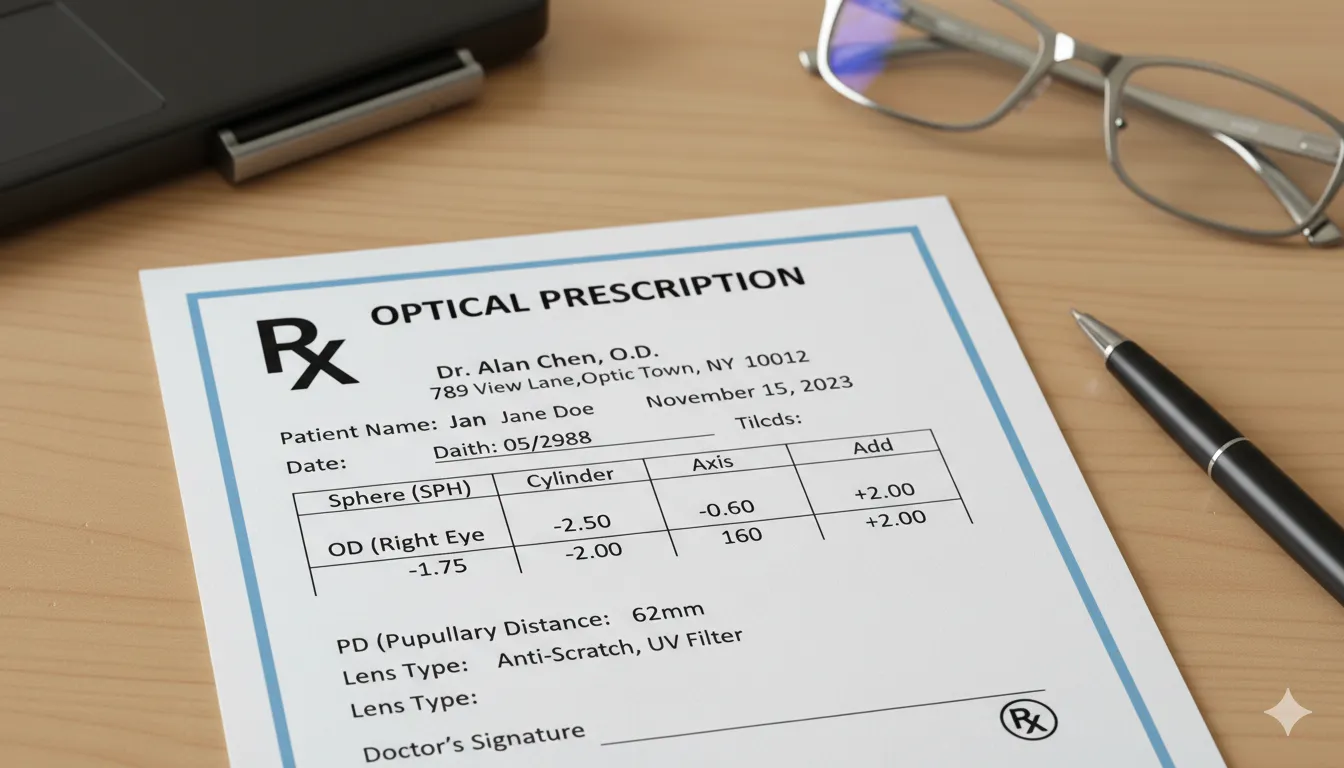
👁️ [Insert Image: Close-up of someone reading a prescription paper] Suggested: Professional photo showing hands holding a prescription

The Basic Abbreviations: OD, OS, and OU

The first thing you’ll notice on your prescription are the letters OD and OS. These aren’t random – they come from Latin and indicate which eye each measurement applies to:

OD (Oculus Dexter) – This means your RIGHT EYE. All measurements in the OD row apply to your right eye only.
OS (Oculus Sinister) – This means your LEFT EYE. All measurements in the OS row apply to your left eye only.
OU (Oculus Uterque) – This means BOTH EYES. You might see this for instructions that apply to both eyes equally.
Remember: OD = Right, OS = Left. A simple trick: “R” comes before “L” in the alphabet, just as “D” comes before “S”!

The Core Numbers: SPH, CYL, and AXIS

Now let’s decode the main measurements on your prescription. These three values work together to correct your vision:

1. Sphere (SPH) – Your Basic Lens Power

The Sphere number indicates the lens power needed to correct your nearsightedness or farsightedness. It’s measured in diopters (D) and always includes either a plus (+) or minus (-) sign:

Minus (-) Sign – Indicates NEARSIGHTEDNESS (Myopia). You can see things close up clearly, but distant objects appear blurry. Example: -2.50 means you need corrective lenses to see far away.
Plus (+) Sign – Indicates FARSIGHTEDNESS (Hyperopia). Distant objects may be clear, but close-up vision is challenging. Example: +1.75 means you need help with near vision.

The higher the number (ignoring the +/- sign), the stronger your prescription. A -5.00 is stronger than -2.00, meaning you need more vision correction.

Example SPH Values:

Eye SPH Meaning Strength
OD -2.00 Nearsighted Moderate
OS -2.50 Nearsighted Moderate

2. Cylinder (CYL) – Astigmatism Correction

The Cylinder value corrects astigmatism, a common condition where your cornea or lens has an irregular shape, causing blurred or distorted vision at all distances. Key points:

  • If this column is BLANK or shows 0.00, you don’t have astigmatism requiring correction
  • CYL values also use minus (-) or plus (+) signs
  • The number indicates how much astigmatism correction you need
  • Common values range from -0.25 to -2.00 for most people

📌 Important Note on Astigmatism

If you have a CYL value, you MUST also have an AXIS value. These two measurements work together – one cannot exist without the other. If you see a CYL number but no AXIS, contact your eye doctor for clarification.

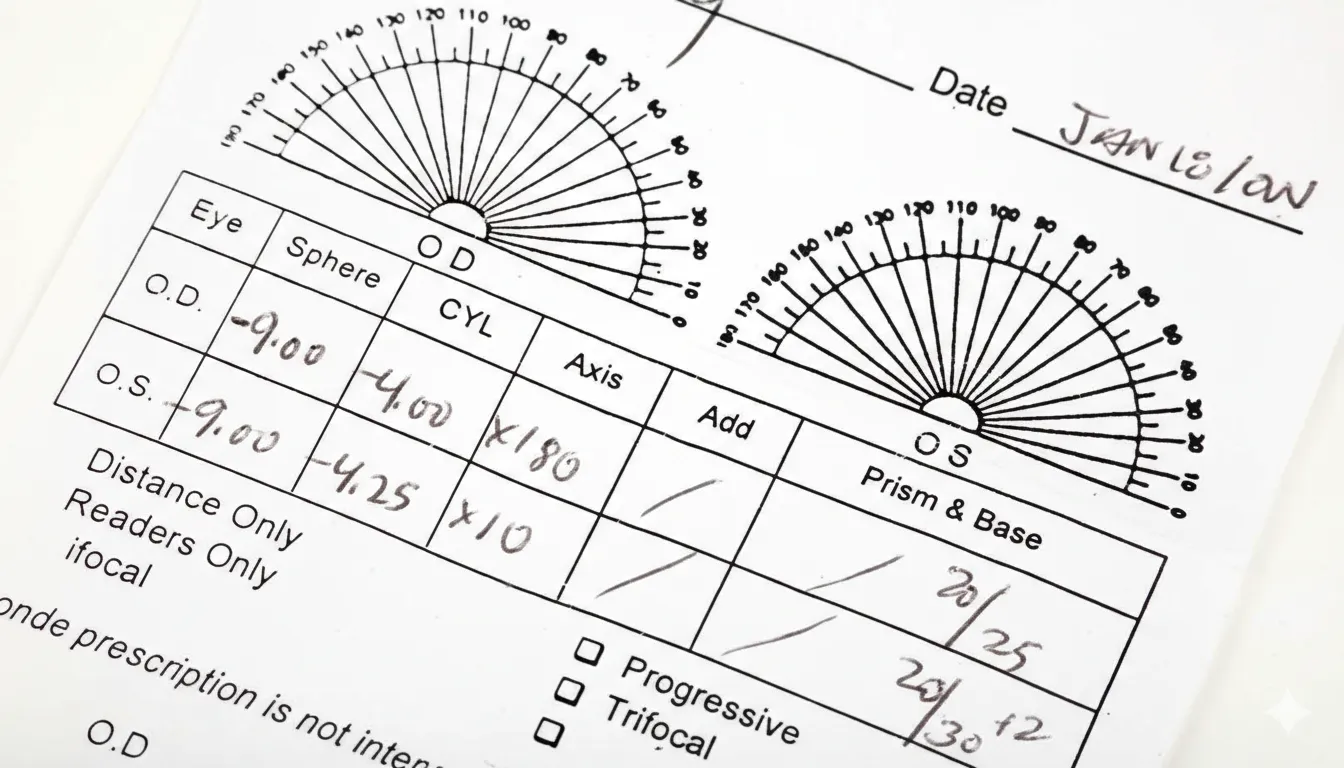
3. Axis – Direction of Astigmatism

The Axis value (ranging from 1 to 180) indicates the orientation of your astigmatism correction. Think of it as describing the angle where the correction needs to be applied:

  • Measured in degrees (like a protractor)
  • Only appears if you have a CYL value
  • Essential for proper lens manufacturing
  • Must be precise – even a few degrees off can affect clarity

Example with Astigmatism:

Eye SPH CYL AXIS Interpretation
OD -3.00 -0.75 180 Nearsighted with moderate astigmatism
OS -3.25 -1.00 15 Nearsighted with moderate astigmatism
🔍 [Insert Image: Diagram showing how astigmatism affects vision] Suggested: Infographic comparing normal vision vs astigmatic vision

Additional Measurements You Might See

ADD (Addition) – For Reading or Bifocals

If you’re over 40 or experiencing presbyopia (age-related difficulty focusing on close objects), you’ll see an ADD value on your prescription. This is always a positive number that gets added to your distance prescription for the reading portion of bifocal or progressive lenses.

Typical ADD Values: Range from +0.75 to +3.00, with +1.00 to +2.00 being most common. This helps you read books, use your phone, or work on a computer comfortably.

At Nine Optic, we offer specialized anti-blue light reading glasses perfect for professionals in Dhaka who spend hours in front of screens.

PD (Pupillary Distance) – Critical for Comfort

Your Pupillary Distance measures the space between your pupils in millimeters. This might be the most important measurement that many people overlook:

  • Why it matters: Ensures the optical center of each lens aligns perfectly with your pupils
  • Typical range: 54-74mm for adults; average is about 63mm
  • Notation: May show as one number (62mm) for both eyes, or two numbers (31/31mm) for each eye separately
  • Importance: Incorrect PD can cause eye strain, headaches, and blurred vision even with a correct prescription
If your prescription doesn’t include PD, ask your eye doctor to measure it. You can also measure it yourself at home using Nine Optic’s online PD measurement guide!

Prism and Base – For Eye Alignment

Some prescriptions include Prism and Base values if you have double vision or eye alignment issues. These measurements help your eyes work together more effectively:

  • Prism: Measured in prism diopters (△ or pd)
  • Base: Indicates direction – IN, OUT, UP, or DOWN
  • Purpose: Corrects how light enters your eyes to reduce strain and double vision

If you have prism correction, it’s essential to order from an experienced optician who understands these specialized requirements.

📏 [Insert Image: Illustration of pupillary distance measurement] Suggested: Diagram showing how to measure PD correctly

Different Types of Prescriptions Explained

Single Vision Prescription

The most common type – corrects vision at one distance (either near or far). Perfect for:

  • Everyday distance glasses
  • Computer glasses
  • Reading glasses
  • Driving glasses

Bifocal Prescription

Features two distinct viewing zones – distance vision in the upper portion and reading vision in the lower segment. You’ll see both your regular prescription and an ADD value.

Progressive (Multifocal) Prescription

Similar to bifocals but with a gradual transition between different viewing zones. No visible line, offering distance, intermediate, and near vision. Ideal for professionals who need clear vision at all distances.

Sample Progressive Prescription:

Eye SPH CYL AXIS ADD PD
OD -2.00 -0.50 180 +2.00 63mm
OS -2.25 -0.75 170 +2.00

Common Questions About Prescriptions

How Long is My Prescription Valid?

In Bangladesh, eyeglass prescriptions are typically valid for 1-2 years for adults and 1 year for children. However, if you notice changes in your vision before then, schedule an eye exam sooner.

Can I Use an Old Prescription?

Using an outdated prescription can strain your eyes and may not provide adequate correction. Your vision changes over time, especially if you spend long hours on digital devices. Regular eye exams are essential.

Why Are My Left and Right Eye Prescriptions Different?

It’s completely normal! Most people have different prescriptions for each eye. Your eye doctor measures each eye independently to ensure optimal vision correction for both.

Can I Order Glasses Without a Recent Prescription?

At Nine Optic, we recommend having an eye exam within the last year before ordering glasses. Using an incorrect or outdated prescription can cause headaches, eye strain, and potentially worsen your vision over time.

✅ [Insert Image: Person reading comfortably with glasses] Suggested: Happy customer wearing glasses from Nine Optic

Tips for Getting the Most from Your Prescription

📋 Essential Steps:

  1. Request a written copy: Always ask for a physical copy of your prescription after your eye exam
  2. Verify all numbers: Double-check that all values are clearly written and readable
  3. Ask questions: Don’t hesitate to ask your eye doctor to explain any values you don’t understand
  4. Check the expiration date: Note when your prescription expires so you can schedule your next exam
  5. Keep it safe: Store your prescription in a safe place or take a photo for backup
  6. Measure your PD: If it’s not included, get this crucial measurement before ordering
When ordering from Nine Optic, our customer service team is always ready to help you understand your prescription and recommend the perfect lenses for your needs!

When to Get a New Eye Exam

Regular eye exams are crucial for maintaining good vision and eye health. Here’s when you should schedule an appointment:

  • Adults (18-60): Every 1-2 years, or annually if you wear glasses/contacts
  • Seniors (60+): Annually, as age-related vision changes are more common
  • Children & Teens: Annually or as recommended by their eye doctor
  • Digital Device Users: Consider annual exams if you spend 6+ hours daily on screens

Schedule an exam immediately if you experience:

  • Sudden vision changes or blurriness
  • Frequent headaches after reading or screen time
  • Difficulty seeing at night
  • Eye pain, redness, or unusual floaters
  • Double vision

Ready to Order Your Perfect Glasses?

Now that you understand your prescription, browse our collection of high-quality eyewear at Nine Optic. From stylish frames to anti-blue light lenses, we have everything you need to see clearly and look great!

Shop Now at Nine Optic

🚚 Free Delivery Inside Dhaka | 👓 100,000+ Happy Customers | ⭐ Premium Quality Guaranteed

Final Thoughts

Understanding your glasses prescription might have seemed complicated at first, but with this guide, you now have the knowledge to confidently read and interpret those numbers. Whether you’re ordering glasses online from Nine Optic or discussing options with an optician, you can make informed decisions about your eyewear.

Remember, your prescription is more than just numbers on paper – it’s the key to clear, comfortable vision. Keep it updated, understand what each value means, and don’t hesitate to ask questions when ordering your next pair of glasses.

At Nine Optic, we’re committed to providing Bangladesh with premium eyewear at affordable prices. Our team is always ready to help you select the perfect frames and lenses based on your prescription and lifestyle needs.

Have questions about your prescription or need help choosing the right glasses? Contact Nine Optic’s expert team today for personalized assistance!

Article written for nineoptic.com

For the best eyewear in Bangladesh, visit Nine Optic