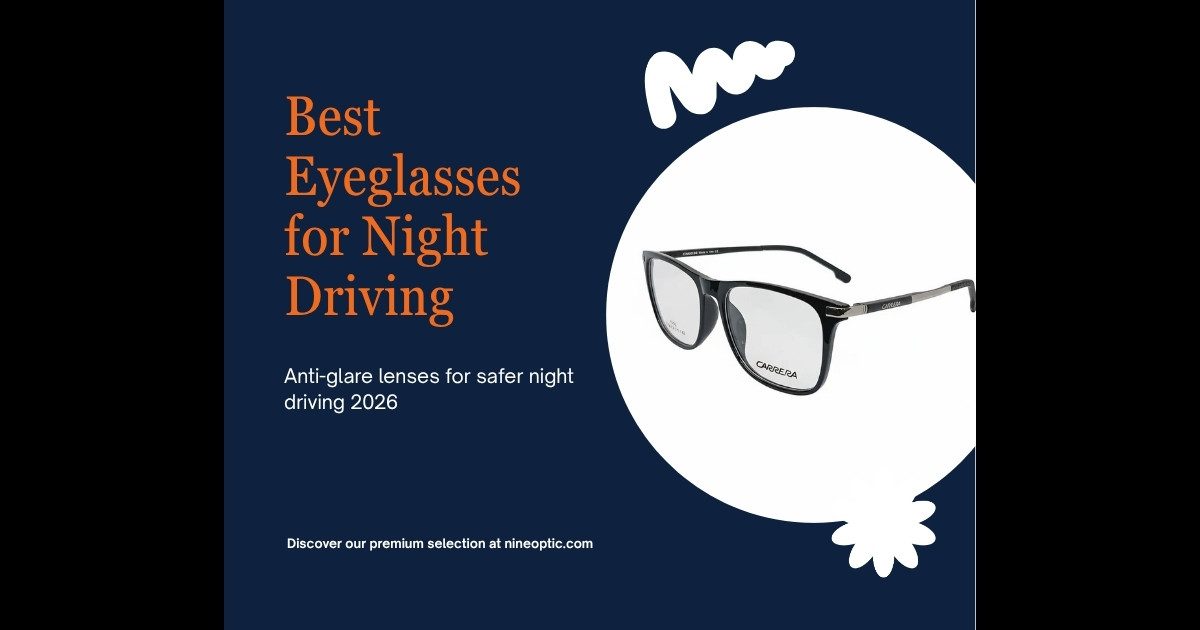
Best Eyeglasses for Driving at Night in Bangladesh 2026
Night driving is one of the most demanding visual tasks we face. Oncoming headlights, wet roads, and reduced ambient light combine to challenge even healthy eyes. If you’ve ever squinted through a rain-soaked windshield at 11 PM, you already know the problem. The right eyeglasses for driving at night can make the difference between a confident journey and a stressful ordeal.
In Bangladesh, where CNG headlights, poorly lit highways, and foggy winters are daily realities, choosing the correct night driving glasses is not a luxury — it is a safety essential.

Why Night Driving is Harder on Your Eyes
Your pupils dilate in low light to let in more photons, but this also increases optical aberrations — blurring and halos around light sources. Add a refractive error (nearsightedness, astigmatism) and the effect multiplies. Oncoming headlights create glare that temporarily blinds you, reducing reaction time. Studies show visual acuity at night can drop by 70% compared to daytime, even in people with perfect daytime vision.
Common night driving complaints include: starbursts around streetlights, difficulty judging distances, eye fatigue after 30 minutes, and headaches from prolonged focus effort.
What Makes a Good Night Driving Lens?
The ideal night driving lens addresses three optical problems simultaneously: glare reduction, contrast enhancement, and anti-reflection coating. Here is what each means in practice:
Anti-Reflective (AR) Coating: This is non-negotiable. An uncoated lens reflects roughly 8–10% of incoming light back toward your eyes — exactly the light you need to see the road. A premium AR coating reduces that reflection to under 0.5%, dramatically improving clarity.
Contrast Enhancement: Some lenses use a slight amber or yellow tint that filters scattered blue wavelengths. This increases contrast between objects and their backgrounds, making road markings and pedestrians pop. However, very dark tints reduce overall light transmission and are counterproductive at night.
Correct Prescription: No lens technology compensates for an uncorrected refractive error. If your prescription is even 6 months outdated, update it before investing in specialty coatings.

Are Yellow-Tinted Night Driving Glasses Actually Effective?
Yellow-tinted glasses are marketed aggressively as “night vision glasses.” The truth is nuanced. A mild yellow tint (10–15% absorption) does improve contrast in foggy or overcast daytime conditions. However, at true nighttime, any tint that reduces total light transmission below 75% makes your vision darker, not better.
The American Academy of Ophthalmology reviewed multiple studies and concluded that yellow-tinted lenses do not significantly improve night driving performance and may actually reduce the amount of useful light reaching your eyes. The real hero is the anti-reflective coating, not the tint.
Our recommendation at Nine Optic: choose clear lenses with a premium AR coating for nighttime use. If you drive frequently in fog or overcast daylight, a very light amber tint with AR coating is a reasonable secondary option.
Anti-Glare Glasses vs Night Driving Glasses: Key Differences
| Feature | Anti-Glare Glasses | Night Driving Glasses |
|---|---|---|
| Primary function | Reduce screen & light reflections | Improve vision in low-light driving |
| Tint | Clear or very light | Clear or mild yellow/amber |
| AR Coating | Standard or premium | Premium (mandatory) |
| Prescription compatible | Yes | Yes |
| Best for | Office screens, indoor use | Night roads, rain, fog |
| Nine Optic price range | BDT 1,500–3,500 | BDT 2,500–5,500 |
Frame Styles That Work Best for Driving
Frame choice affects your field of vision while driving. A frame that is too thick or too tall can block peripheral vision — dangerous when checking mirrors or merging lanes.
Recommended frame styles for driving: thin metal or titanium frames with minimal temple width, half-rim frames that leave the bottom of your visual field unobstructed, and wrap-style frames for highway driving where wind and dust are factors. Avoid overly large acetate frames with thick rims for driving use — they create blind spots at the frame edges.

Lens Coatings That Help at Night
Beyond basic AR coating, several advanced treatments improve night driving performance:
Oleophobic (oil-repellent) coating: Fingerprints and smudges scatter light in all directions. An oleophobic top coat keeps lenses cleaner between wipes, maintaining optical clarity during long drives.
Hydrophobic (water-repellent) coating: Rain droplets on lenses scatter oncoming headlights into a halo effect. A hydrophobic coating causes water to bead and roll off instead of spreading across the lens surface. Essential for Dhaka’s monsoon season driving.
Scratch-resistant hardcoat: Micro-scratches from cleaning with improper cloths scatter light similarly to rain droplets. A premium hardcoat keeps the optical surface pristine for 2–3 years with proper care.
Best Frames for Night Driving Available at Nine Optic
At Nine Optic, we stock frames specifically suited to driving conditions. Our Alfio and Carrera collections include lightweight titanium and stainless steel options with thin temples that maximize your peripheral field of view. Each frame can be fitted with our premium AR-coated lenses with hydrophobic and oleophobic treatments.
Our optical team will help you choose the correct lens index for your prescription — thinner lenses (1.67 or 1.74 index) reduce edge distortion at the periphery, which is particularly noticeable during nighttime driving when your pupils are dilated.
Common Mistakes When Buying Night Driving Glasses in Bangladesh
Mistake 1: Buying heavily tinted yellow glasses from street vendors. These reduce light transmission by 30–40%, making your overall vision darker with no real benefit.
Mistake 2: Using an expired prescription. If your glasses are more than a year old, the prescription may no longer match your eyes. Night driving amplifies any uncorrected error.
Mistake 3: Skipping the AR coating to save money. Without AR coating, every oncoming light source creates a second ghost image from the lens surface, doubling your glare problem.
Mistake 4: Choosing fashion frames over functional ones. A wide acetate frame with thick rims may look great, but it genuinely restricts peripheral vision during driving.
How to Care for Your Night Driving Glasses
Proper care extends the life of your coatings and maintains optical clarity. Always use a microfiber cloth — never paper tissue or your shirt, which contain wood fibers that scratch the hardcoat. Rinse lenses under lukewarm water before wiping to remove dust particles that act like sandpaper. Store glasses in a hard case when not in use. Avoid leaving glasses on a car dashboard where UV and heat degrade coatings rapidly.
In Bangladesh’s humid climate, clean your lenses every day — dust and humidity combine to create a thin film that scatters light just like micro-scratches.
When to See an Eye Doctor Before Driving at Night
Night driving difficulty can sometimes indicate underlying conditions beyond simple refractive error. Night blindness (nyctalopia) can be caused by vitamin A deficiency, early-stage cataracts, or glaucoma. If you notice a sudden worsening of night vision, halos that have grown significantly larger, or difficulty that affects only one eye, consult an ophthalmologist — not just an optician — before assuming new glasses will solve the problem.
Nine Optic recommends a comprehensive eye exam every 12 months, especially for anyone who drives regularly after dark. Your safety and the safety of others on the road depends on accurate, up-to-date vision correction.
Frequently Asked Questions
Do night driving glasses actually work?
Glasses with premium anti-reflective coating genuinely reduce glare from headlights. Yellow-tinted “night vision” glasses have mixed evidence and may reduce total light reaching your eyes.
What is the best lens coating for night driving in Bangladesh?
A premium multi-layer AR coating combined with a hydrophobic (water-repellent) top coat is ideal for Bangladesh’s monsoon driving conditions.
Are anti-glare glasses good for night driving?
Yes. Anti-glare (AR-coated) glasses significantly reduce the halo and starburst effects from oncoming headlights, improving both comfort and reaction time.
Can I use the same glasses for day and night driving?
Yes, if they have a clear prescription lens with AR coating. Avoid photochromic (transition) lenses for driving — they may not fully clear in a car because windshields block the UV needed to activate the de-tinting process.
How much do anti-glare glasses cost in Bangladesh?
At Nine Optic, prescription anti-glare glasses with AR coating start from BDT 2,500 for frame and lens combined. Premium options with hydrophobic and oleophobic coatings range up to BDT 5,500.
Is night driving without glasses dangerous if I have a mild prescription?
Even a mild prescription (-0.5 to -1.0) can significantly affect night vision, when your pupils dilate and increase optical aberrations. Wear your glasses while driving at night regardless of prescription strength.
Do Nine Optic glasses come with AR coating by default?
All Nine Optic prescription lenses include a standard AR coating. You can upgrade to premium multi-coat with hydrophobic and oleophobic treatments at checkout or through our WhatsApp consultation.
Which frame material is best for driving glasses?
Lightweight titanium or stainless steel frames are best for driving. They are thin, durable, and provide an unobstructed peripheral field of view compared to thick acetate frames.
Share This Story, Choose Your Platform!
About the author : Khurshid Zaman

Optician, Nine Optic