Kids Eye Problems Caused by Mobile Usage: Protect Your Child’s Vision
Smartphones, tablets, and laptops have become inseparable companions for children in Bangladesh. Whether it is online classes, YouTube videos, or mobile games, children today spend 4–8 hours daily in front of screens. This dramatic shift in how children spend their time is creating an equally dramatic rise in pediatric eye problems that eye doctors across the country are increasingly concerned about.
As parents, understanding the specific risks, recognizing warning signs early, and taking protective measures — including kids blue light glasses and screen time management — can prevent long-term damage to your child’s vision.

How Screens Affect Children’s Developing Eyes
Children’s eyes are still developing until approximately age 18. The crystalline lens in a child’s eye is more transparent than an adult’s, meaning more short-wavelength blue light (380–500 nm) reaches the retina. This is the same high-energy light emitted by smartphone and tablet screens. Over years of exposure, this can accelerate retinal fatigue and potentially contribute to long-term photoreceptor stress.
Additionally, the focusing muscle (ciliary muscle) in young eyes is highly responsive. Holding a screen close for extended periods — the average child holds a phone just 25–30 cm from their face — causes the ciliary muscle to remain contracted continuously. Over months and years, this sustained accommodation stress is the primary driver of childhood myopia progression.
The Myopia Epidemic Among Bangladeshi Children
Myopia (nearsightedness) rates among school-age children in South Asia have increased dramatically over the past decade. Studies from the region show that urban children, who spend more time indoors with screens and less time outdoors, develop myopia at rates 2–3 times higher than rural children with equivalent genetic backgrounds.
In Dhaka, pediatric optometrists now routinely encounter children as young as 6 or 7 presenting with significant myopia — a condition that was rare at those ages a generation ago. Each diopter of myopia increases the child’s lifetime risk of retinal detachment, glaucoma, and macular degeneration.

Warning Signs Your Child May Have Screen-Related Eye Problems
Children rarely self-report vision problems because they assume everyone sees the way they do. Parents must watch for behavioral and physical signs. Frequent eye rubbing, especially during or after screen use, indicates digital eye strain. Sitting progressively closer to the TV or holding books very close to the face suggests developing myopia. Complaints of headaches in the forehead or temples during homework or after using devices often indicate accommodation fatigue.
Other warning signs include squinting to see distant objects (blackboard at school, signboards from a vehicle), watery or red eyes after screen time, and reports of “blurry” or “double” vision. If your child tilts their head when reading or covers one eye, this may indicate binocular vision problems requiring professional evaluation.
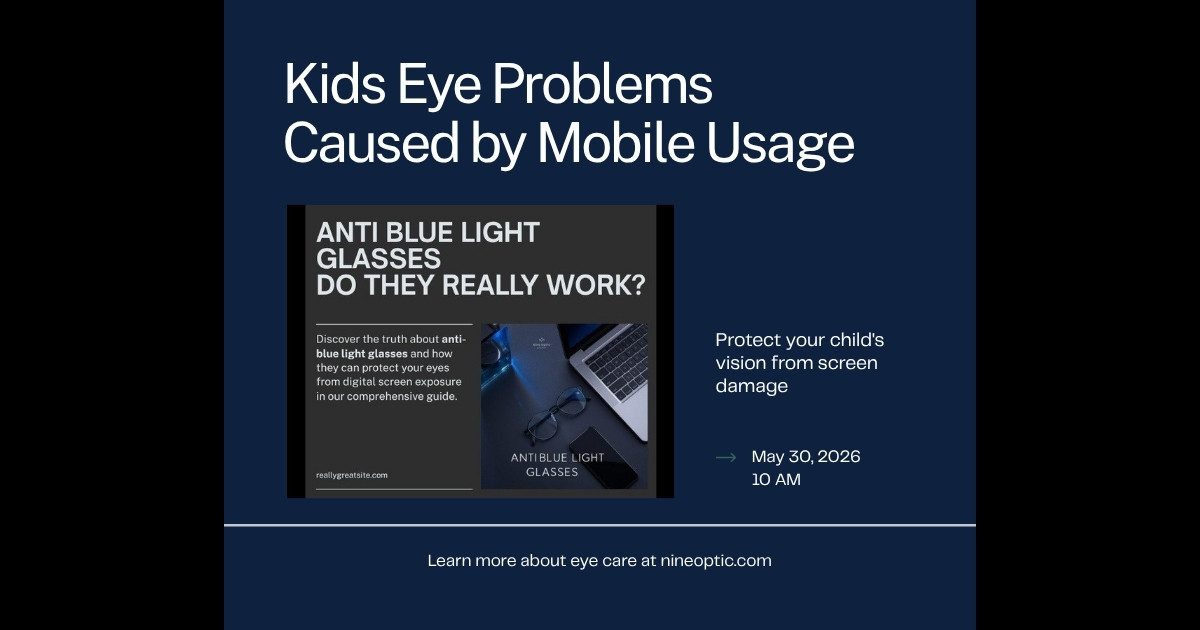
What Are Kids Blue Light Glasses and Do They Help?
Blue light filtering glasses use a lens coating or material that absorbs or reflects the high-energy blue wavelengths (380–450 nm) before they reach the eye. For children, the benefit is primarily in reducing the visual fatigue and sleep disruption associated with evening screen use.
Blue light from screens suppresses melatonin production — the hormone that signals the body to prepare for sleep. When children use screens within 1–2 hours of bedtime, their sleep onset is delayed and sleep quality degrades. Children who sleep less than 9 hours show accelerated myopia progression in multiple studies. Blue light filtering glasses used in the evening hours can partially mitigate this effect.
It is important to note that blue light glasses alone do not prevent myopia. They reduce eye strain and protect sleep quality, but the primary driver of myopia is near-work distance and outdoor time, not blue light exposure per se.
Screen Time Guidelines for Children by Age
| Age Group | Recommended Daily Screen Time | Minimum Outdoor Time | Screen Distance |
|---|---|---|---|
| Under 2 years | 0 minutes (except video calls) | 2+ hours | N/A |
| 2–5 years | 30–60 minutes | 2+ hours | 50+ cm |
| 6–10 years | 1–2 hours | 1.5–2 hours | 45–50 cm |
| 11–14 years | 2–3 hours | 1–1.5 hours | 40–45 cm |
| 15–18 years | 3–4 hours (non-study) | 1 hour | 40+ cm |
The 20-20-20 Rule for Children
Every 20 minutes of screen time, have your child look at something 20 feet (6 meters) away for 20 seconds. This simple practice relaxes the ciliary muscle and prevents sustained accommodation fatigue. For young children, make it a game — set a timer and have them find objects outside the window during each break. This is the single most evidence-based behavioral intervention for reducing digital eye strain in children.
Combine the 20-20-20 rule with conscious blinking exercises. Children blink 30–50% less frequently during screen use compared to other activities, which causes tear film instability and dry eye symptoms. Remind children to “blink hard 10 times” during their 20-second break.

Outdoor Time: The Most Powerful Myopia Prevention Tool
Research consistently shows that children who spend 1–2 hours outdoors daily develop myopia at significantly lower rates than those who spend all their time indoors. The mechanism is thought to involve dopamine release stimulated by bright outdoor light (10,000+ lux outdoors vs. 300–500 lux indoors), which inhibits the axial elongation of the eye that causes myopia.
In Bangladesh, where outdoor play has decreased due to safety concerns, heat, and academic pressure, parents should deliberately create outdoor time. Early morning hours (7–9 AM) and evening hours (5–7 PM) offer adequate bright light with tolerable temperatures for outdoor activity. Even 30 minutes twice daily provides measurable protective benefit.
Choosing the Right Blue Light Glasses for Your Child
When selecting screen time glasses for children, consider durability first — children need flexible frames that can withstand dropping, bending, and rough handling. TR-90 nylon and spring-hinge acetate frames are excellent choices. Avoid metal frames with sharp hinges for children under 10.
For lens options: if your child has a prescription, always get corrective lenses with blue light filtering added as a coating — do not use non-prescription blue light glasses if your child needs vision correction. The blue light filter can be added to virtually any prescription at Nine Optic for a small additional cost.
If your child has no refractive error, protective non-prescription blue light glasses are a reasonable addition for evening screen use and homework sessions. Ensure they fit properly — a frame that slips down the nose constantly will not be worn.
Nine Optic’s Recommendation for Kids’ Eye Protection
At Nine Optic, we offer blue light filtering lenses for children’s frames with options starting from BDT 1,800 for frame plus lens. Our optical team can help you select the correct frame size for your child’s facial dimensions — an ill-fitting frame that sits too far from the eyes reduces the effectiveness of any lens treatment.
We recommend scheduling your child’s first comprehensive eye exam by age 3–4, then annually from school age onward. Early detection of myopia allows intervention (myopia management lenses or orthokeratology) that can slow progression before it becomes severe.
Frequently Asked Questions
At what age should children start wearing blue light glasses?
There is no strict minimum age. If a child is regularly using screens for 1+ hours daily, blue light glasses can be beneficial from around age 4–5 onward. For children under 2, screens should be avoided entirely.
Can mobile phones cause permanent eye damage in children?
Prolonged close screen use is a significant contributor to myopia progression, which is permanent. Severe myopia increases lifetime risk of retinal problems. Screen use does not typically cause immediate permanent damage, but cumulative effects over childhood are serious.
Do blue light glasses prevent myopia in kids?
No. Blue light glasses reduce eye strain and protect sleep quality but do not directly prevent myopia. The strongest evidence-based myopia prevention strategy is outdoor time (1–2 hours daily).
How can I tell if my child needs glasses?
Watch for squinting, sitting close to screens or TVs, frequent eye rubbing, headaches during reading, or complaints of blurry vision. Schedule a professional eye exam — children often cannot articulate vision problems clearly.
What is the best screen distance for children?
A minimum of 40–50 cm for tablets and 60+ cm for laptops. Hold the screen at arm’s length as a rough guide. Never allow screen use lying down, where the distance drops dangerously close.
Are Nine Optic kids glasses durable?
Yes. We stock TR-90 flexible frames and spring-hinge designs specifically for children. These withstand the inevitable drops and bends that come with active children.
Can children wear photochromic lenses?
Yes. Photochromic lenses that automatically darken outdoors are an excellent choice for children, providing UV protection outdoors and clear vision indoors without needing separate sunglasses.
How much do kids blue light glasses cost in Bangladesh?
At Nine Optic, blue light filtering glasses for children start from BDT 1,800 with frame and lens included. Prescription options with blue light filter start from BDT 2,200.
Share This Story, Choose Your Platform!
About the author : Dr. Asifur Rahman

Senior Consultant, Bangladesh Eye Hospital, Dhaka