Progressive Lens vs Single Vision Lens: Bangladesh Buyer’s Guide 2026
At some point in your early 40s, something frustrating happens: you start holding your phone further away to read it, and your reading glasses make it impossible to see across the room. This is the moment most Bangladeshis discover they need a choice — keep switching between two pairs of glasses, or invest in a lens that handles everything. That choice is usually between single vision lenses and progressive lenses, and it’s one of the most common questions our team fields every week at Nine Optic.
This guide explains the difference clearly, breaks down who needs which type, what they cost in Bangladesh in 2026, and what the three most common mistakes buyers make when choosing between them.
What is a progressive lens, really?
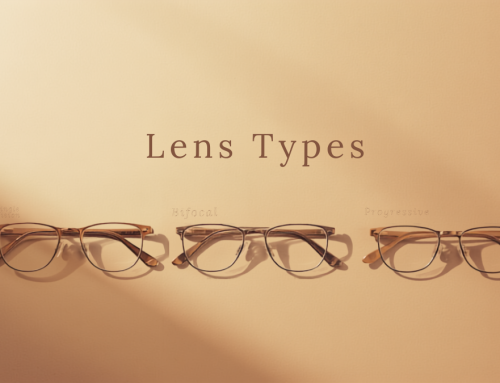
A progressive lens — also called a multifocal lens — contains three vision zones in a single lens, with no visible line between them. The top zone corrects distance vision (reading road signs, watching TV, seeing across a room), the bottom zone corrects near vision (reading, phone screens, documents), and the middle zone handles intermediate distances (computer screen, dashboard, supermarket shelves).
The word “progressive” refers to the gradual, seamless change in lens power from top to bottom. Unlike bifocals — which have a visible line and a harsh jump between zones — progressive lenses transition smoothly, which is why they’re sometimes called “no-line bifocals” in everyday language.
Single vision lenses, by contrast, correct only one distance — either near or far, but not both. Most Bangladeshis under 40 who need glasses wear single vision lenses. The transition to progressive or bifocal happens when presbyopia sets in — the natural age-related loss of the eye’s ability to focus at multiple distances, typically beginning between age 38 and 45.
Why progressive lenses are becoming popular in Bangladesh
Five years ago, bifocals were the default prescription for Bangladeshi patients over 40. The visible line of a bifocal was considered acceptable — even expected. That’s changing fast. Nine Optic has seen progressive lens orders grow consistently since 2022, driven by three factors.
First, Bangladesh’s office workforce has expanded significantly, and screen-heavy work has made intermediate vision (the computer distance) much more important than it used to be. Bifocals don’t handle this well — they jump from distance to near with nothing in between. Progressive lenses fill this gap naturally.
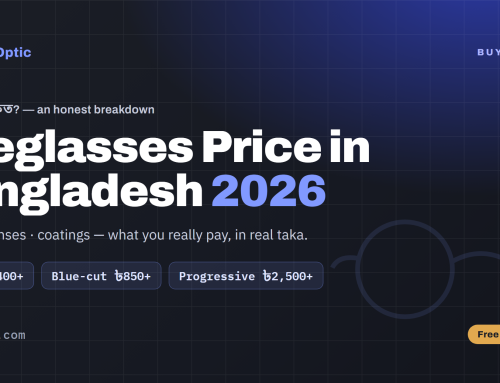
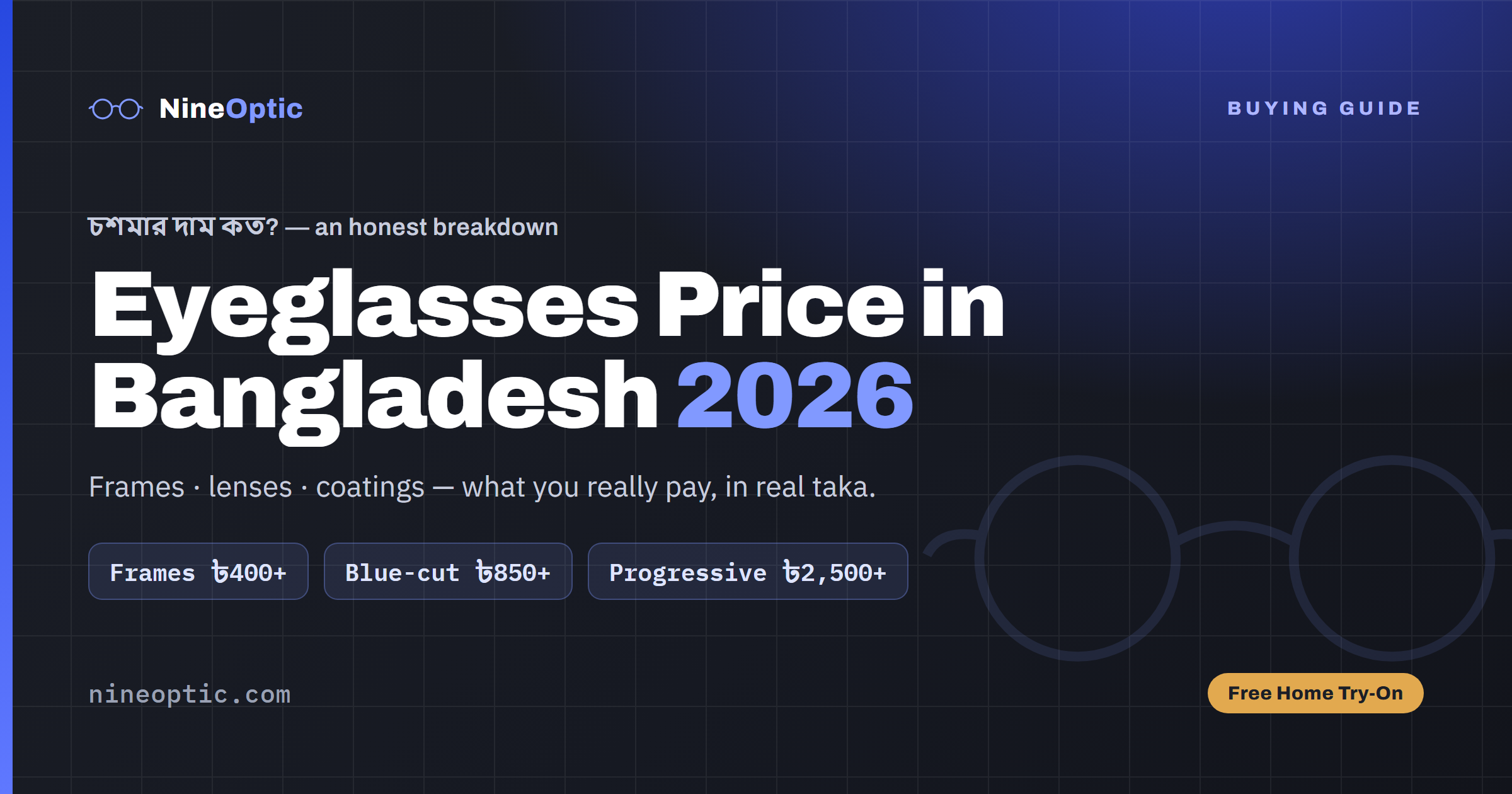
Second, progressive lenses have come down in price. In 2018, a quality progressive lens in Dhaka cost ৳8,000–৳15,000. Today, entry-level progressive lenses start at ৳3,500 at Nine Optic, with mid-range options at ৳5,500–৳9,000 and premium international brands like Essilor and Hoya available from ৳12,000. The premium has narrowed dramatically.
Third, awareness has improved. More people know that progressive lenses exist as an option, and younger presbyopia patients — early 40s — prefer them over bifocals because they look identical to single vision glasses.
Progressive vs single vision — price guide Bangladesh 2026
Here’s what each lens type costs at Nine Optic in 2026. Frame cost is separate and varies from ৳1,350 to ৳35,000+ depending on brand.
| Lens type | Price range (lens only) | Best for | Notes |
|---|---|---|---|
| Single Vision (standard) | ৳500 – ৳900 | Under 40, one correction needed | Most common, widest frame compatibility |
| Single Vision (anti-blue / AR) | ৳900 – ৳2,500 | Office workers, screen users under 40 | Add coating for screen protection |
| Progressive (entry) | ৳3,500 – ৳5,500 | Early presbyopia, mild prescription | Narrower reading zone, adaptation period needed |
| Progressive (premium — Essilor, Hoya, Zeiss) | ৳12,000 – ৳28,000 | Regular wearers, high prescription, drivers | Wider zones, faster adaptation, best optics |
Prices are 2026 Nine Optic rates. Premium international lens prices may vary based on import costs.
Lens technology: progressive vs bifocal vs single vision
Understanding the technical differences helps you make a better buying decision — and avoid being sold the wrong thing by an optical shop that only stocks one type.
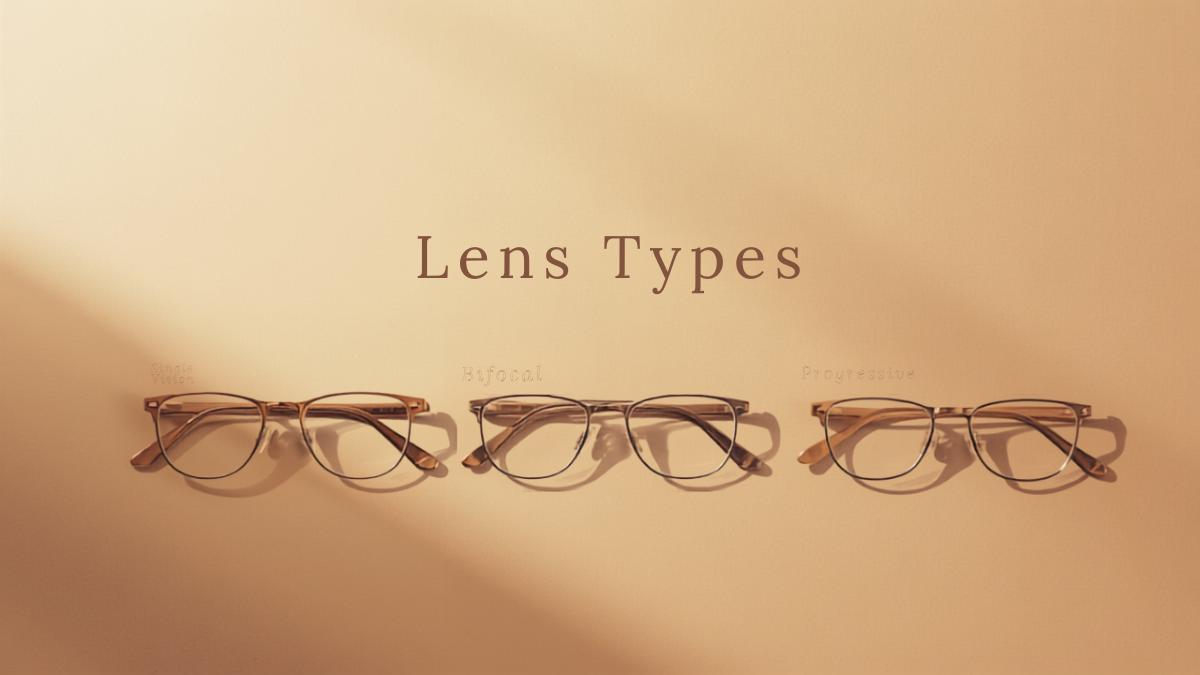
Single vision lenses have a uniform prescription across the entire lens surface. They’re the simplest, cheapest, and easiest to adapt to. If you only need correction for one distance — near or far, not both — single vision is always the right choice, regardless of age.
Bifocal lenses have two distinct zones separated by a visible line. The top corrects distance, the bottom corrects near. They’re cheaper than progressives and work well for tasks that are clearly either “far” or “near” — like driving and then reading. The downsides: the visible line is cosmetically obvious, and there’s no intermediate zone, so computer work at arm’s length remains blurred.
Progressive lenses eliminate the line and add the intermediate zone. The trade-off is a learning curve — most new progressive wearers take 1–2 weeks to train themselves to look through the correct zone for each distance. Looking through the side edges of a progressive lens causes distortion (this is unavoidable with current lens technology). Premium progressive lenses minimize this distortion significantly.
Our recommendation: If you’re over 40 and need correction for both near and far, progressive is almost always the better long-term investment. If your lifestyle is mostly either-or (long-distance driving OR close reading, not both), bifocal is acceptable. If you’re under 40, stick with single vision plus appropriate coatings.
How to choose the right lens for your prescription in Bangladesh
The choice isn’t just about age — it’s about your prescription power and your daily routine. Here’s a practical guide:
- Addition power matters most. Progressive lenses are prescribed with an “addition” (+ADD) value that indicates how much extra power is needed for near vision. A low addition (ADD +1.00 to +1.50) means early presbyopia — entry-level progressives work well. A high addition (ADD +2.50 to +3.50) needs wider lens zones — premium progressives are strongly recommended.
- Your frame size affects the progressive corridor. The “corridor” is the intermediate channel in the progressive lens. Small frames (lens height under 28mm) don’t leave room for a proper progressive corridor. Always choose a frame with at least 30mm of lens height for progressives.
- Occupational progressives exist. If you spend 8+ hours daily at a computer, Nine Optic carries “office lenses” — a type of progressive optimized for near-to-intermediate distances, with a wider near zone and a computer zone. These aren’t good for driving, but they’re transformative for desk workers.
- High prescription patients need thinner lenses. If your SPH is above ±4.00, a 1.67 or 1.74 high-index progressive lens is worth the premium — it’s noticeably thinner and lighter than a standard 1.50 progressive, which matters when you’re wearing the glasses all day.
Pros and cons of progressive lenses — the honest list
Pros:
- One pair covers distance, intermediate, and near — you stop carrying multiple glasses.
- No visible line — looks identical to single vision glasses.
- Better for modern screen-heavy lifestyles — computer distance is covered.
- Premium progressives offer significantly wider vision zones and less peripheral distortion.
Cons:
- Adaptation period of 1–2 weeks — some wearers experience dizziness or headaches initially.
- Peripheral (side) distortion is unavoidable in all progressives — premium lenses reduce but don’t eliminate this.
- Not ideal for very small frames (lens height under 28mm).
- Cost significantly more than single vision — entry-level progressives start at ৳3,500 vs ৳500 for single vision.
The 3 biggest mistakes when buying progressive lenses in Bangladesh
1. Choosing entry-level progressives for a high prescription. Entry-level progressive lenses have a narrow corridor and significant peripheral distortion. For prescriptions above SPH ±3.00 or ADD above +2.00, entry-level progressives often cause such discomfort that patients stop wearing them. The prescription exists to help you see — if you can’t adapt to the lens, it’s money wasted. For high prescriptions, mid-range or premium progressives (Essilor, Hoya, Zeiss) make the difference between success and failure.
2. Choosing a frame that’s too small or trendy for progressives. Small, narrow “trendy” frames look stylish but are terrible for progressive lenses. A lens height under 28mm gives the progressive manufacturer almost no room to fit the near, intermediate, and distance zones. The result: a usable near zone the size of a postage stamp. Always ask Nine Optic’s team to confirm frame compatibility before ordering progressives.
3. Not disclosing your daily activities to the optician. The lab needs to know where you spend most of your time visually. A driver who also reads a lot needs a different progressive design than a software developer who rarely drives. “Occupational” progressives, driving progressives, and general-purpose progressives are different products. Nine Optic’s optical team in Dhaka will ask the right questions — but if you’re ordering from a less specialized shop, volunteer this information.
Where to get progressive lenses in Bangladesh
Nine Optic’s in-house optical lab in Dhaka cuts and fits progressive lenses to prescription for all major international brands — Essilor (Varilux), Hoya, Zeiss, and Crizal. You can upload your prescription on the website, choose a compatible frame, select your lens type, and have your glasses delivered anywhere in Bangladesh via COD.
For customers in Dhaka, our free home trial service lets you try frames at home before committing — which matters for progressives, since frame compatibility with the progressive corridor is critical. See our progressive lens page for full pricing and specifications.
Also relevant: our guide on why people over 40 need reading glasses covers the presbyopia biology in more depth, and our rimless eyeglasses price guide explains which frames work best with progressive lenses.
How to care for progressive lenses
- Clean from the top-down, not side-to-side. Wiping in a circular or side-to-side motion can gradually damage the progressive coating at the zone boundaries. A gentle top-to-bottom motion with a clean microfiber cloth is safer.
- Avoid extreme heat. Progressive lenses have a laminated coating structure more sensitive to heat than standard single-vision lenses. Bangladesh’s car dashboards in summer (60–70°C interior) will damage them within weeks. Store them in your bag or glove compartment.
- Use only approved lens cleaners. Alcohol-based cleaners, hand sanitizer, or household glass spray will strip anti-reflective coatings. Nine Optic includes a lens cleaning spray with every progressive lens order — use it.
Frequently Asked Questions
What is the difference between progressive and bifocal lenses?
Bifocal lenses have two visible zones separated by a line — distance on top, near at the bottom — with no intermediate zone. Progressive lenses have three zones (distance, intermediate, near) with no visible line and a gradual power transition. Progressives are cosmetically superior and handle computer/screen distances that bifocals miss, but cost more and have a short adaptation period.
What is the price of progressive lenses in Bangladesh?
At Nine Optic, progressive lenses start at ৳3,500 for entry-level (standard 1.50 index) and go up to ৳28,000 for premium Essilor Varilux or Zeiss progressives in high-index materials. Frame cost is additional. Most Bangladeshi buyers in the office professional segment opt for the ৳5,500–৳9,000 mid-range progressive, which offers a noticeably wider corridor than entry-level.
At what age should I switch from single vision to progressive lenses?
There’s no fixed age — it depends on when presbyopia begins affecting your daily life. Most Bangladeshis notice the change between age 38 and 45. The clearest signal is needing to hold reading material (phone, book, menu) at arm’s length to read it clearly. At that point, a comprehensive eye exam and a progressive prescription are worth considering.
How long does it take to adapt to progressive lenses?
Most new progressive wearers adapt within 1–2 weeks. During this period, you may experience mild dizziness, headaches, or the sensation that floors look “wavy.” This is normal. Wear the glasses consistently (don’t alternate with your old single vision pair) and the adaptation happens faster. Premium progressive lenses (Hoya, Essilor Varilux) have wider corridors that significantly reduce adaptation difficulty.
Can I use progressive lenses for driving in Bangladesh?
Yes — and many Dhaka drivers prefer them because they provide clear distance vision (traffic, signs, mirrors) while also allowing glances at the dashboard and navigation without removing glasses. However, don’t use the near zone (bottom of the lens) while driving — it requires a head tilt that’s unsafe. Keep your gaze through the top two-thirds of the lens while driving.
Are progressive lenses good for computer use?
Standard progressives cover computer distance through the intermediate zone, but the corridor can be narrow. If you spend 6+ hours daily at a computer, an “office progressive” or “computer progressive” lens — sometimes called a degressive lens — offers a much wider intermediate zone optimized for screen distances. Nine Optic’s Dhaka team can advise which progressive design suits your work setup.
Can I get progressive lenses online in Bangladesh?
Yes — Nine Optic allows you to upload your prescription online, choose a compatible frame, and select progressive lenses with full customization (index, coating, brand). We cut the lenses at our in-house Dhaka optical lab and deliver nationwide via COD. For high prescriptions or unusual PD measurements, our team will confirm the order by WhatsApp before processing.
What frames work best with progressive lenses?
Frames with a lens height of at least 30mm work best for progressives. Rectangular or square frames in medium-to-large sizes are ideal. Very small oval frames, narrow rimless designs, and cat-eye frames with a very high top cut can restrict the progressive corridor. Nine Optic will flag frame-lens compatibility before confirming your order.
Final word: the right lens for the right stage of life
Single vision lenses are excellent — for the stage of life where one correction is all you need. Progressive lenses are the intelligent upgrade for when your vision needs have outgrown a single focal point. Neither is objectively “better”; the right choice depends on your prescription, your daily activities, and your budget.
What we do know from seven years of fitting prescriptions in Bangladesh is this: people who invest in a quality progressive lens — mid-range or premium — rarely go back to bifocals or single vision pairs. The convenience of one clear pair for everything changes how you experience daily life, whether you’re driving in Dhaka traffic, reading a report, or watching a cricket match.
Explore Nine Optic’s progressive lens collection → · International brands · Full prescription customization · COD across Bangladesh · Free home trial in Dhaka.
Also in this series: Why People Over 40 Need Reading Glasses · Best Online Eyewear Store in Bangladesh 2026
Share This Story, Choose Your Platform!
About the author : Dr. Asifur Rahman

Senior Consultant, Bangladesh Eye Hospital, Dhaka