
Why People Above 40 Need Reading Glasses: A Complete Bangladesh Guide
You’re forty-two. You’ve never needed glasses in your life. Then one evening, you’re reading a WhatsApp message and you notice your arm is fully extended — the phone is as far from your face as it can go — and the text is still slightly blurry. You squint a bit. You move your head back. You blame the screen brightness.
You don’t need to blame anything. What’s happening is normal, predictable, and affects every Bangladeshi adult eventually. It’s called presbyopia, and it’s the single most common reason people start needing reading glasses after 40. This guide explains exactly what is happening to your eyes, the seven warning signs you’re probably already noticing, how reading glasses fix it instantly, how to choose the right reading power (it’s simpler than you think), and where to buy authentic, affordable reading glasses online in Bangladesh with cash on delivery.
What exactly is presbyopia?
Inside your eye, behind the pupil, sits a small flexible lens. When you were 20, that lens could change shape effortlessly — thin for distance vision, thicker for close-up reading. By the time you’re 40—45, that lens has gradually stiffened. It can’t flex enough to focus on close objects anymore. Hold a book at the normal reading distance of 30—40 cm and the text goes soft. Push the book to arm’s length, and the text suddenly snaps into focus — because your stiffening lens can now manage that further focal point but not the closer one.
This is presbyopia (Greek for “old eye”). It’s not a disease, not a sign of any underlying eye problem, and there’s no exercise, diet, or supplement that reverses it. Every human eye undergoes this change. In Bangladesh, where the average adult spends 4—6 hours daily on phones, presbyopia symptoms tend to show up around age 40—43 — sometimes a few years earlier for heavy screen users.
The good news: reading glasses solve it instantly. The optical lens adds the focusing power your natural lens has lost. Put them on, and small text snaps into clarity. Take them off for distance vision, which still works perfectly fine.
7 signs you need reading glasses (most Bangladeshi adults notice 3 or more)
- You hold your phone, newspaper, or book further away from your face than you used to. Classic first sign.
- Small text on menus, packaging, medicine labels, and SMS messages looks blurry, especially in dim light.
- Your eyes feel tired after 20—30 minutes of reading, with mild headaches at the front of your head or behind your eyes.
- You squint or tilt your head back to focus on close-up text.
- Reading under low light has become noticeably harder — you find yourself needing brighter lamps to read at night.
- You unconsciously increase font size on your phone from 12pt to 14pt, then 16pt, then larger.
- Threading a needle, reading product details on a shop label, or checking the expiry date on a medicine strip takes longer than it used to.
If you’re recognizing yourself in three or more of these, you’re in the normal age-related curve. Reading glasses fix it within seconds of putting them on.
How reading glasses actually work
Reading glasses are simple positive-power (+) optical lenses. They add focusing power that your natural eye lens can no longer produce on its own. The strength is measured in diopters — a unit you’ll see written as “+1.00”, “+1.50”, “+2.00” etc. The higher the number, the stronger the magnification, and the closer your eye can focus.
The lens itself looks like any normal eyeglass lens. What differs is the prescription strength and the fact that reading glasses are typically single-vision — optimized for one focal distance (about 30—40 cm). When you look up to see something across the room, the world goes blurry through the lenses — which is why you take them off or look over the top of the frame for distance.
If you want a single pair of glasses that works for both near AND distance vision, you don’t want reading glasses — you want progressive lenses (a smooth transition from distance at the top to reading at the bottom). We’ll cover those briefly later.
Choosing the right reading power: a simple Bangladeshi buyer’s guide

For first-time reading glasses buyers without a recent eye test, the simplest method is to match your age to a starting power. This isn’t medical advice — just a practical starting point that works for most people:
| Your age | Likely starting power |
|---|---|
| 40—44 | +0.75 to +1.00 |
| 45—49 | +1.25 to +1.50 |
| 50—54 | +1.75 to +2.00 |
| 55—59 | +2.25 to +2.50 |
| 60+ | +2.50 to +3.00 |
If you’re unsure between two powers, go with the lower one — it’s gentler on your eyes during the adjustment period. You can always step up six months later as the natural progression continues.
The best move, if you can manage it, is to get an eye test from an optometrist in Bangladesh first (most optical shops do this free with a frame purchase). A proper test gives you your exact prescription including any astigmatism correction you might need. We offer free eye checkups at our Uttara, Dhaka showroom.
Frame styles that work for mature faces
Reading glasses don’t have to look like “old-people glasses” — the styles available in Bangladesh today are far more modern than a decade ago. The frame choices that flatter most mature Bangladeshi faces:
- Rimless frames: Lightweight, almost invisible, professional. Perfect for office workers and anyone who wants the glasses to fade into the background. Try our rimless eyeglasses collection.
- Half-rim (semi-rimless): Metal top, transparent bottom. A traditional “intellectual” look. Light on the face.
- Round acetate: Classic, warm, sophisticated. Suits oval and square faces beautifully.
- Rectangular acetate: Modern, structured. Good for round faces.
- Titanium frames: Premium, ultra-lightweight, won’t corrode in Bangladesh’s humidity. Worth the investment if you’ll wear glasses daily for years.
Avoid frames that are too small (cuts off the reading zone) or too wide for your face (slides down the nose). The frame should sit comfortably on the bridge of your nose without pinching, and the temples should rest gently against your head without squeezing.
Anti-blue light + reading combo: worth the extra ৳300—৳500
If you read on screens (phone, laptop, Kindle, tablet) more than on paper, ordering your reading glasses with an anti-blue light coating is a smart upgrade. The coating filters the high-energy blue light from screens, reducing eye strain, late-evening sleep disruption, and the mild headaches that come from extended screen reading. The Nine Optic anti-blue reading range combines reading power with anti-blue coating in a single lens.
The Nine Optic V004 Royal Vision is our bestseller in this category — rimless, lightweight, anti-blue, available in reading powers from +0.50 to +3.00, at ৳1,290.
Common myths about reading glasses (none are true)
- “Reading glasses will make my eyes lazy and weaker.” False. Reading glasses don’t affect the natural progression of presbyopia — which would happen anyway whether you wear them or not.
- “If I start wearing them, I’ll be dependent forever.” You’ll be “dependent” in the sense that your near vision needs help, which it does regardless of whether you put on glasses. The glasses don’t cause it.
- “Cheap roadside reading glasses are fine.” They’re fine for occasional emergency use. But the lens centers (where the optical power is positioned) on cheap pairs often don’t align with your pupils — causing eye strain over time. Properly fitted reading glasses make a noticeable difference within a week.
- “Eye exercises can reverse presbyopia.” Not according to mainstream ophthalmology. There’s no evidence that any exercise restores the flexibility of an aged lens.
Where to buy authentic reading glasses online in Bangladesh
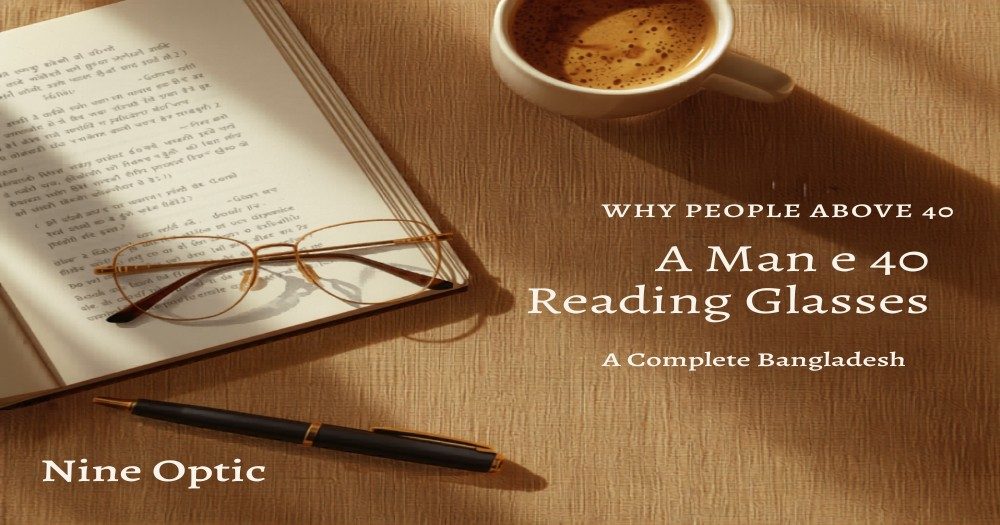
At Nine Optic, our reading glasses collection covers the full power range from +0.50 to +3.00, in budget options starting around ৳500 and premium rimless/titanium frames up to ৳3,000. Every pair:
- Comes with optical-quality lenses — not the cheap plastic blanks on roadside stalls
- Includes a hard case and lens cleaning cloth in the box
- Can be ordered with anti-blue or anti-glare coating add-ons
- Ships with Cash on Delivery across all 64 districts of Bangladesh
- Carries a 7-day no-questions exchange policy if the fit isn’t right
If you’re close to Dhaka, our Uttara showroom (87 BNS Center, 5th Floor) offers free reading-power testing — pop in, get tested, walk out with the right pair fitted in 20 minutes.
Frequently Asked Questions
At what age do most Bangladeshi adults start needing reading glasses?
Most people notice the first signs of presbyopia between 40 and 45. For heavy screen users, it can start slightly earlier (38—40). By age 50, the vast majority of Bangladeshi adults need some form of reading correction.
Can I just use my spouse’s reading glasses?
Only as a temporary test. If the power happens to match, you’ll see the difference, but daily use with someone else’s prescription often causes eye strain because lens centers don’t line up with your pupils. Get your own pair fitted to your face.
Do reading glasses work for screen reading?
Yes, but the focal distance matters. Reading glasses are typically optimized for 30—40 cm (paper book distance). If your laptop screen sits 50—60 cm away, a slightly lower power (or dedicated computer glasses) may feel more comfortable.
How long do reading glasses last?
The frame itself can last 5—10 years with care. The reading power, though, typically needs increasing every 2—3 years as presbyopia progresses — so plan on a fresh lens fitting in that timeframe even if the frame is still good.
Are progressive lenses better than reading glasses?
Progressive lenses let you use one pair for both distance AND near vision (smooth power gradient from top to bottom). They’re ideal if you want to wear glasses constantly. Pure reading glasses are simpler, cheaper, and better if you only need help with close-up tasks.
How do I know if a Bangladeshi online optical shop is selling authentic reading glasses?
Check for: proper optical-quality lens (not plastic blank), a clear return policy, real product photography, Cash on Delivery option, and ideally a physical showroom you can visit. Avoid sellers with no return policy, no phone number, or prices that seem implausibly low for the quality described.
Can reading glasses cause headaches?
Properly fitted reading glasses should reduce headaches, not cause them. If you get headaches from new reading glasses, the power is likely too strong, too weak, or the lens centers don’t align with your pupils. Get a refund or fitting adjustment.
Should I get one pair or two?
Two is smart for most people: one pair to keep at your desk/workspace, another for the bedside table or to carry in a bag. Reading glasses are forgettable accessories, and the second pair saves you ten minutes of searching.
Ready to get the right reading glasses?
Browse the complete Nine Optic reading glasses collection. Filter by power, frame style, color, or budget. Every order ships across Bangladesh with Cash on Delivery, hard case included, and a 7-day exchange policy if the fit isn’t right. If you’d rather come in for a free reading-power test, visit our Uttara showroom.
Visit: 87 BNS Center, 5th Floor, Uttara, Dhaka 1230
Call: 01715-846007
Shop online: nineoptic.com
Reviewed and published by Khurshid, Founder of Nine Optic. Over a decade fitting Bangladeshi customers with prescription eyewear and reading glasses.
Share This Story, Choose Your Platform!
About the author : Dr. Salma Akter

Eye Specialist, Renevo Eye Hospital, Dhaka